The world’s deepest river: How the Congo reaches depths equal to a 70-storey building |
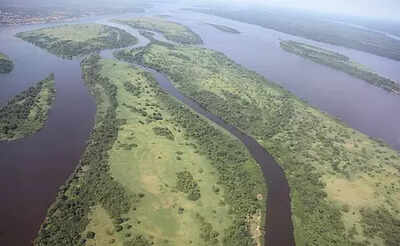

The Congo River is ranked first on this list since it is the deepest river in the world. It creates a 4,700 km system that drains the enormous Congo Basin, Africa’s second largest rainforest region, and flows through the Democratic Republic of the Congo, Republic of the Congo, and Angola. Significant amounts of freshwater and sediment are dumped into the Atlantic by the Congo, which is also the second longest river in Africa and the third largest in the world by discharge. Because it is the only significant river to cross the Equator twice, its flow is remarkably consistent throughout the year. In addition to supporting incredibly rich aquatic life, its turbulent gorges and cataracts including the well-known Livingstone Falls create tremendous depths and hydroelectric potential that may potentially provide much of sub Saharan Africa’s electricity demand.
Deepest river in the world according to Guinness world record
According to Guinness world records, the Congo River, which flows through ten African nations, has a maximum depth of at least 220 meters, according to research done in July 2008 by the US Geological Survey and the American Museum of Natural History. Echo sounders, differential GPS, and acoustic Doppler current profilers were used to conduct the measurements in the Lower Congo River.
Congo River: Deepest river in the world
Flowing through six countries in West-Central Africa, Cameroon, the Republic of the Congo, the Democratic Republic of the Congo, the Central African Republic, Equatorial Guinea, and Gabon. The Upper Congo, Middle Congo, and Lower Congo are its three divisions. With its headwaters situated in the highlands of the East African Rift, the Congo may be traced back to Eastern Africa. The two main tributaries of the Congo are the Chambeshi River, which rises in Zambia, and the Lualaba River, which is supplied by lakes Mweru and Tanganyika. In the Democratic Republic of the Congo’s town of Moanda, the river empties into the Atlantic.The river travels around 4700 kilometres near the equator, passing it twice before emptying into the Atlantic Ocean. After the Amazon River in South America, it is also the second-largest river in the world in terms of discharge volume. The biodiversity of the Congo River is abundant. At least 400 species of mammals, 1,000 species of birds and 700 fish species, including several endemic species, are known to exist in the Congo River Basin, making it one of the highest in the world. Given that a significant portion of the river is still unexplored, the number may be higher.
The population of the Congo River Basin
According to the World Wildlife Fund, there are currently about 75 million people living in the Congo River Basin, representing 150 different ethnic groups. Humans have inhabited the region for 50,000 years.Prominent hunter-gatherer tribes known as Pygmies, such the Ba’Aka, BaKa, BaMbuti, and Efe, are found there. According to a 2015 assessment published in the journal Current Anthropology, the non-hunter-gatherer communities in the region have been dependent on subsistence farming and bartering for products for thousands of years.The Congo Basin rainforest is so valuable for sequestering carbon dioxide and producing oxygen that scientists have called the rainforest the world’s “second lungs,” following the Amazon rainforest, according to the European Space Agency.